

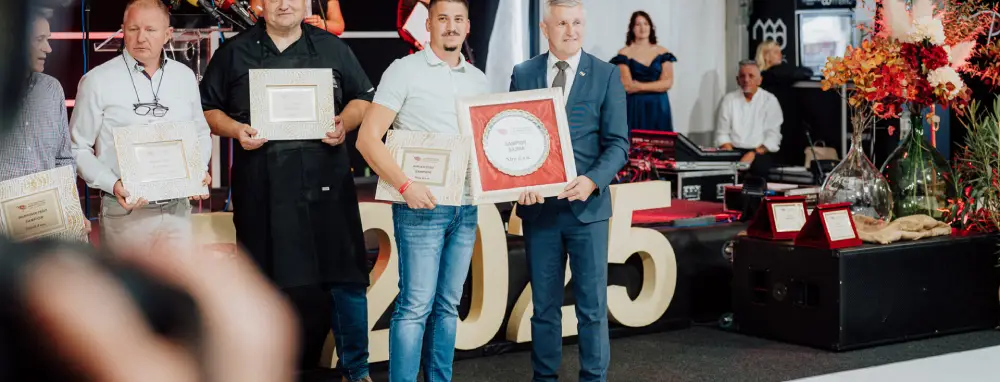
Champion titles were awarded across four categories at the 17th International Prosciutto Fair (ISAP) in Istrian Tinjan. In the international category, the top honour went to the pršut (Croatian dry-cured ham) of the Mij company from the Slovenian village of Peče near Grosuplje. The best Istrian pršut is made by Pršutarna selo Mekiši, the best Dalmatian by Smjeli of Dugopolje, the best undried by Pršutarna i stancija Buršić of Vodnjan, and the best smoked by Nira of Pakovo Selo near Drniš. Their Drniš pršut was also proclaimed the overall champion of the Vodnjan ISAP 2025 fair.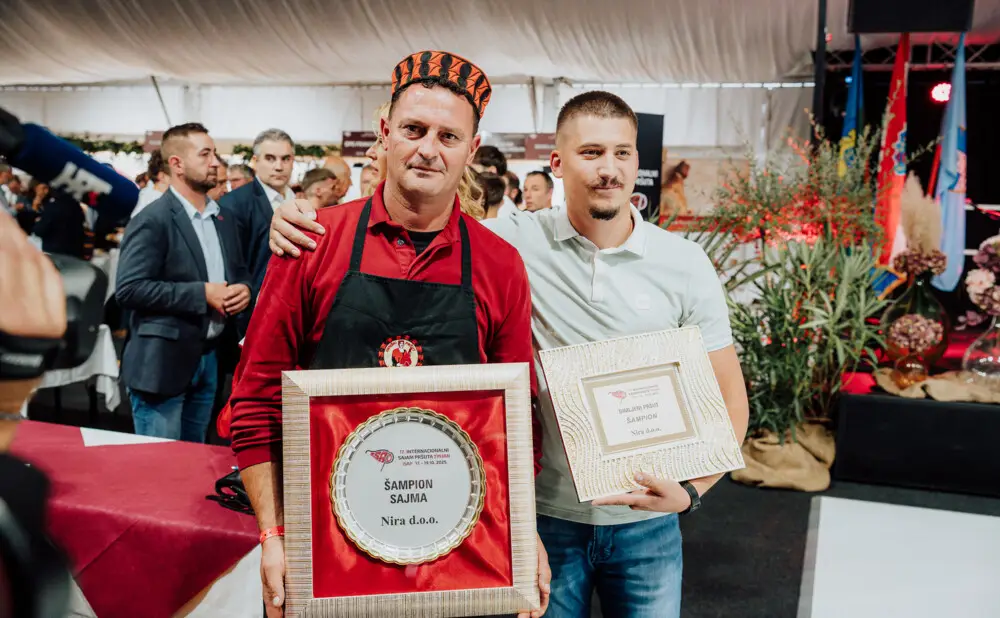
Prosciutto is not merely a delicacy; it is a symbol of tradition, labour, patience and pride. When we launched this story 17 years ago, we wanted to create a meeting place, not only of flavours but of culture. Today, on the threshold of adulthood, we can proudly say that our fair has outgrown its local frame and become one of the most important gastronomic events in Croatia and beyond, said Goran Hrvatin, head of the Municipality of Tinjan. Producers from Italy, Spain, Slovenia and Montenegro also exhibited, and 48 hams were entered for judging, four more than last year. Among the visitors was also President Zoran Milanović.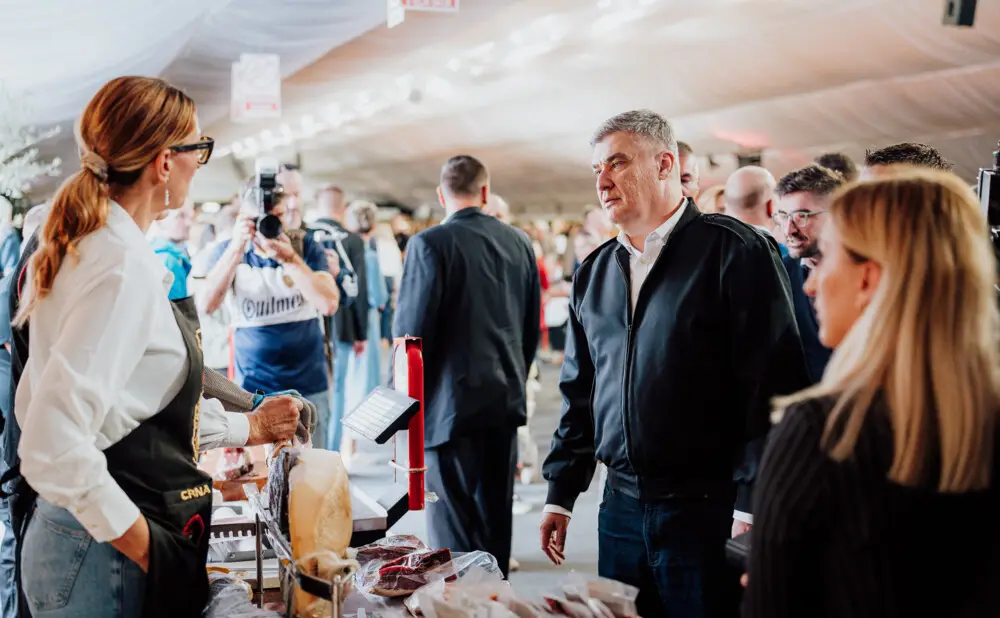
Pršut — specifically the Krk variety — was the first Croatian product to earn a Protected Geographical Indication at European Union level. Dalmatian and Drniš pršut now hold the same protection, while Istrian pršut carries a Protected Designation of Origin. That is a higher level of protection, one that also prescribes the origin of the meat, which must come from around a dozen Croatian counties. The Krk, Drniš and Dalmatian hams, meanwhile, must be produced in the traditional manner of the area to which the protection applies, though the origin of the raw material — the legs — is not prescribed. The curing of the legs also differs, and consumers will most easily sense the differences with their nose. Put very simply, the Istrian and Krk hams are air-dried only, while the Dalmatian is first smoked and then air-dried. 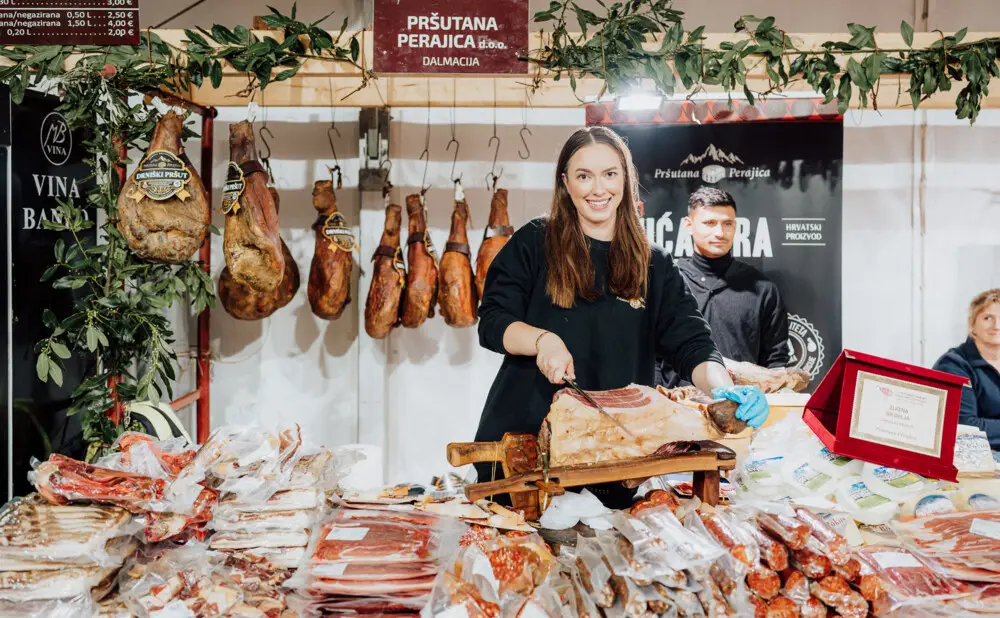
The wine to accompany a pršut should be chosen accordingly. Undried ham, above all the Istrian, calls for a soft white wine such as a white Pinot or an aged Malvazija Istarska (Istrian Malvasia). Since this ham carries no smoke and less fat, it suits wines of good structure and a more pronounced alcoholic softness, lower aromatic intensity and moderate acidity. Smoked Dalmatian and Drniš hams, on the other hand, call for wines with more aromatics, higher acidity and a fuller body. This might be a fuller rosé, a white Pošip or a Sauvignon of calmer aromatics, and among the reds the lighter Crljenak and Babić.
19.10.2025.