


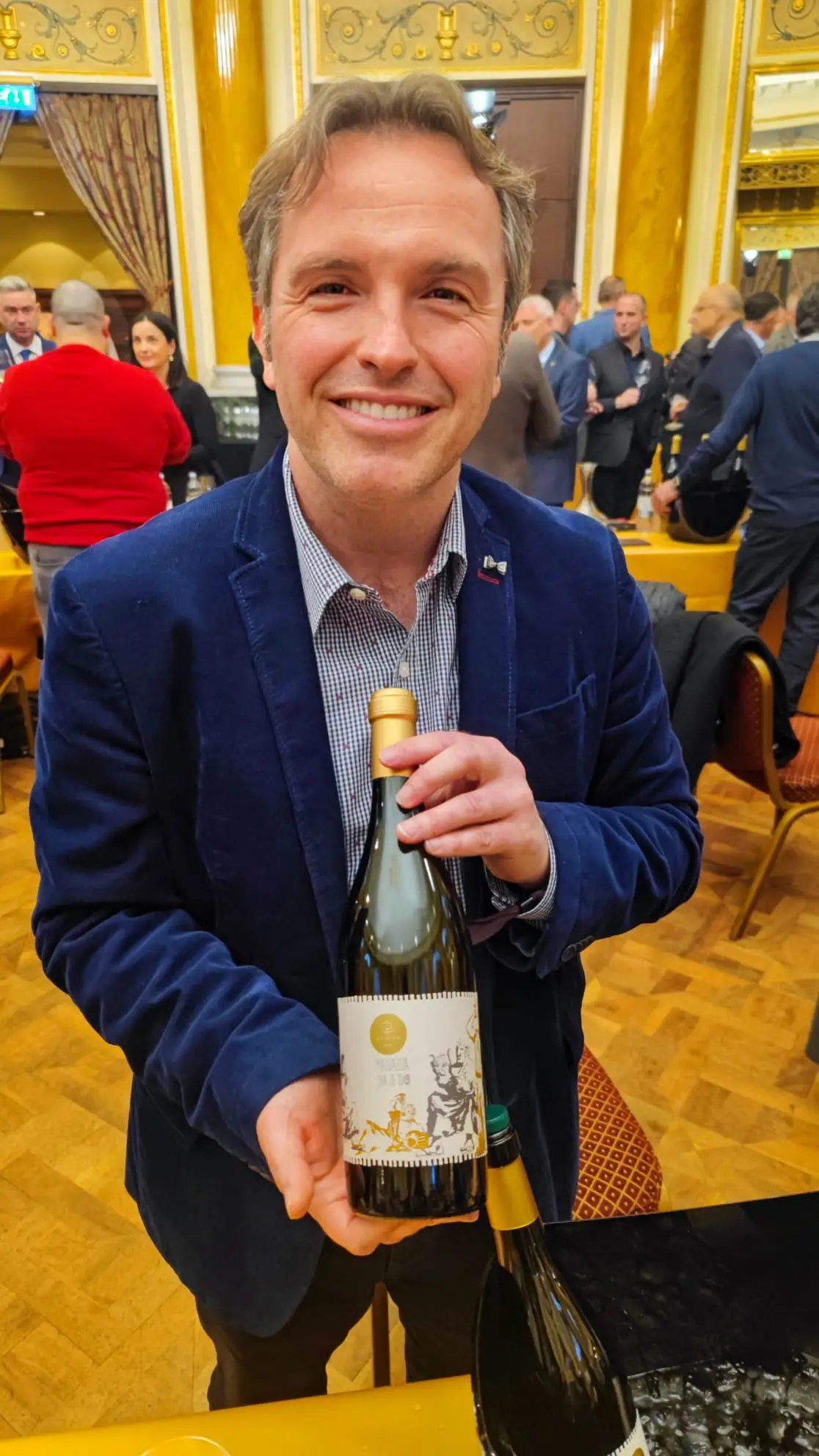
Krešimir Kožić is one of Croatia’s most respected wine experts, and probably our finest connoisseur of the global wine scene. It is a pleasure to introduce him as our new columnist, whose reflections and experiences you will be able to follow every Thursday on nobilis777.space. Born and raised in the centre of Zagreb, he graduated from law school and worked as a lawyer until 2010, from which point he began to work professionally with wine. He currently works as a wine educator and consultant with more than 15 years of professional experience, and, more recently, as a collaborator of Vinski klub.
– How did your wine story begin – at what moment did you realise that wine could become an important part of your professional and private life?
A serious interest in wine came to me relatively late, in my early thirties. The decisive moment was Christmas 2010, when my late father-in-law Martin Šepetavc steered me towards Rhine Riesling and later taught me most of what I know about wine today.
I must also mention Edvard Udženija, Robert Samek, Darko Lugarić, Ivan Jug, Goran Petrić and Marko Rundek. Each of them, in his own sphere, has been part of my development over the years.

– How do you see the current state of Croatian winemaking, and where is there room for progress?
Croatian winemaking is making continuous, but slow, progress. In my view, the Croatian wine presence on the international stage needs to be redefined, with an exclusive emphasis on indigenous varieties.
– Are our many indigenous varieties sufficiently represented in overall wine production?
They are represented, but their presence needs further work, and we need a precise definition of the organoleptic characteristics of wines from our indigenous varieties, because that would significantly help their positioning on the international market.
– What are the global trends, and in which direction is the wine industry heading?
The global trends point to lighter, more vibrant wines with lower alcohol, both red and white. Total wine sales worldwide have been in continuous decline for some time now. The causes are varied and numerous, and because of its breadth this subject warrants a separate analysis. Wine has been drunk for thousands of years, and that will not stop any time soon. Perhaps what awaits us is a redefinition of wine as a cultural phenomenon.
– Who will hold on to their positions and who will lose them, and do you see China as a serious threat to the global wine market?
The established markets will hold their positions, especially those that closely follow world wine trends while at the same time contributing to the preservation of wine tradition.
China is not a serious threat, because the idea of Chinese wine producers is, first and foremost, to establish dominance in their own, enormous market. Investment by wealthy Chinese in the wine industry beyond their own country is in decline.
– Wines made with minimal intervention are today, entirely justifiably, ever more in the public eye; amber and long-macerated wines feature on every serious wine list, and there are also Pet-Nat sparkling wines and some lesser-known, alternative stylistic forms. Which wine trends do you consider overrated, and which have a real, long-term future?
As for minimal-intervention wines, that is an extremely broad category that is not defined at all – neither by regulation nor by style. My position is that 20% of these wines are genuinely very good to excellent, while 80% are largely not worth mentioning. My greatest objection is when blatant faults spotted in these wines are dressed up as the so-called character of the wine.
– Will climate change redefine the wine regions?
Global climate change will redefine a great many things in the wine industry over the next 30 years. Broadly speaking, cooler climates will profit while the warmer ones will face certain difficulties. We can also expect a more significant share of so-called PIWI varieties (varieties resistant to fungal diseases) in the world’s future total wine output.
– What are your favourite wine regions and varieties?
I will define my favourite varieties rather than regions, since some of these varieties are found across a significant number of wine regions, each with its own particularities. In no particular order, my favourite white varieties are Albariño, Carricante, Chardonnay, Godello, Rhine Riesling and Grüner Veltliner. Among the reds they are Pinot Noir, Mencía, Nebbiolo, Nerello Mascalese and Syrah.
– How does one recognise good value for money, and what are the biggest mistakes people make when buying wine?
The answer is not simple. The average wine buyer has to rely on their local merchant at the wine shop. You need to follow publications that write about wine, and find a wine critic whose palate resembles your own – and you will manage that in only one way: by tasting as many wines as possible. With the recommendation being one glass of excellent wine, rather than a bottle or more of a poor one.
– Which five wines should everyone taste at least once?
A German Riesling GG, a Chablis Grand Cru, a Pinot Noir from Burgundy, a Syrah from the northern Rhône and, of course, a good red Bordeaux.
– A closing message?
A great wine is always better enjoyed in good company.