

 Written by: Krešimir Kožić, Vinski klub
I have always wondered why Croatian wine lovers, for the most part, do not like Riesling. As an example, I can offer a family friend who enjoys drinking wine and whose favourite variety is Sauvignon Blanc, but when it comes to Riesling she says: “Oh, no!”
Why is this so, and what are the reasons that Riesling has such relatively poor traction here in Croatia? There are several, and we shall look into them a little.
First we shall turn to the name, which here carries an unfortunate synonym, “rajnski” (Rhine Riesling), a hangover from the days of the former Yugoslavia. There were, and still are today, wines such as “laški rizling” and “talijanski rizling” (Welschriesling and Italian Riesling), which in fact come from a variety we know and love well – Graševina. But wines labelled “laški” and “talijanski” ought to be avoided, even though they remain entrenched in Hrvatsko Zagorje along the Slovenian border (read: undrinkable acid bombs). This does not mean Graševina should be avoided. On the contrary! I am a great lover of Graševina.
Riesling is – and not merely in my subjective view – one of the greatest, if not the greatest, white variety in the world. It is not without reason that it is fondly called the “king of the vineyard”. It is remarkably versatile, capable of yielding everything from an extremely dry sparkling wine to an ice wine, and as such belongs to a very narrow group of varieties that possess these qualities. It is temperamental in the vineyard and demands great care, together with a winemaker who knows what they are doing in the cellar. When all of the above conditions align, the result is a truly great wine.
But is that wine “great” only for a narrow circle of wine professionals, “geeks” and like-minded enthusiasts, or is it a so-called niche wine that will truly appeal only to certain groups? The answer is not simple, and it calls for a certain look not only at the Croatian but at the general wine mentality of an audience that drinks wine now and then. Simply put: highly drinkable, smoothly gliding, quickly inviting the next sip, not tart, and so on. These are all the traits of the best-selling wines in most Croatian wine shops and supermarkets. Nor does it help that most of Croatia’s most popular indigenous varieties are the complete opposite of Riesling in their organoleptic properties, or flavour.
A good dry Riesling is always a somewhat complicated wine, demanding both extra attention from the taster and, in most cases, food as an accompaniment. It is undeniably easier to drink a low-acid wine at a bar than a Riesling – at least for the general public. Some of Croatia’s more competent sommeliers tell me that off-dry or medium-sweet Riesling is the category most easily presented to the public and most readily accepted by it. Interestingly, women take to Riesling in these categories far more readily than men.
So why does Riesling carry that negative connotation in Croatia? First of all, there is its aromatic spectrum, which is always complex. High-tier Rieslings open slowly and have a very complex “nose” that at times is simply too much for the average wine lover. Especially problematic are the petrol-and-kerosene notes that Riesling sometimes develops with bottle age. Most of the public simply does not accept these notes. Then there is the broad spectrum of flavours a top Riesling develops on the palate, always accompanied by that high acidity. For some, that acidity is always too much. A great Riesling is always drunk slowly; it demands attention, changes in the glass over time, and is not necessarily a wine for one extra bottle or two. It is an outstanding partner to food. Depending on its category, Riesling can accompany anything from very simple dishes to haute cuisine. It is highly popular in Michelin-starred restaurants the world over.
Now a little about the styles, countries and regions of Riesling.
Austria
In this country Riesling is always dry, somewhat higher in alcohol and body, with a rather unique aromatic spectrum emphasising riper white and yellow fruit, alongside ever-present herbal notes. The best-known regions are Wachau, Kremstal, Kamptal and Traisental. The most famous wine is FX Pichler Riesling Unendlich.
Germany
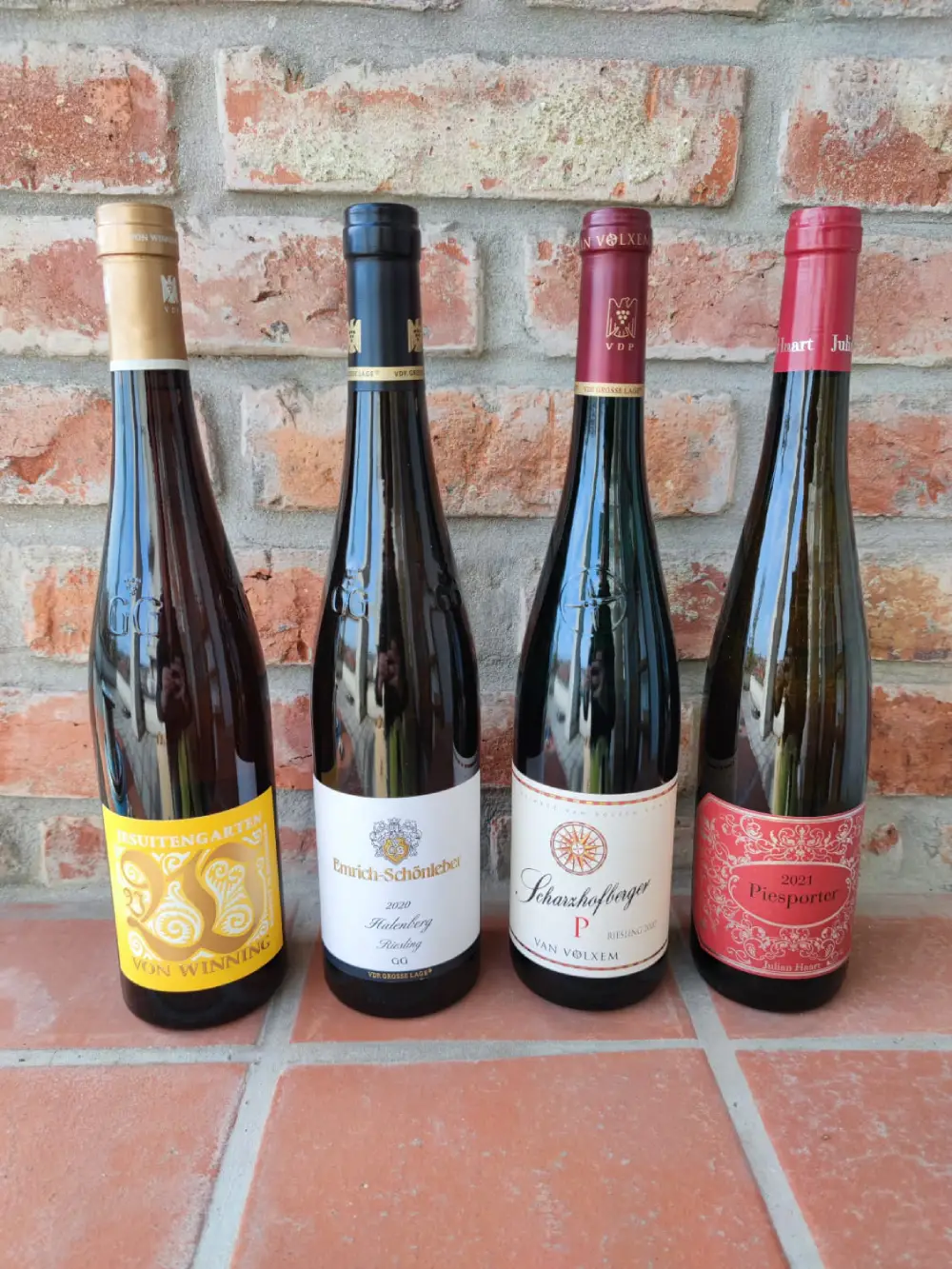
The most important country for Riesling, where every category we listed at the start of this article is produced. The best-known regions are the Mosel (Saar and Ruwer), Nahe, Rheingau, Rheinhessen, Pfalz and Franken. Germany’s specialities are the Feinherb category (off-dry under Croatian legislation) and Kabinett (from off-dry to medium-sweet). German dry Riesling is always medium-bodied, with more restrained fruit notes and more pronounced terroir character. The most famous wines are Egon Müller Riesling Scharzhofberger Kabinett and Keller Riesling G-Max.
France
Here Riesling is found in the Alsace region, where it can broadly be divided into two categories. One consists of the so-called “Catholic” wines, the other the “Protestant” ones. What is the distinction? The “Catholic” wines contain a more pronounced level of unfermented sugar, while the “Protestant” ones are always brutally dry. Whatever the division, Alsace Riesling is always a touch more alcoholic and fuller-bodied than the German, and in that sense comparable to the Austrians. It is in Alsace Rieslings that, after a certain period of ageing, one most readily detects precisely those petrol-and-kerosene notes that the Croatian public accepts with difficulty. Over the past 15 years or so, wines from a third category have emerged, in fact a golden mean between the two above. The finest examples are Trimbach Riesling Clos Sainte Hune and Zind-Humbrecht Riesling Rangen de Thann Clos Saint Urbain Grand Cru.
In the rest of Europe, excellent Riesling can be found in Switzerland and in Italy – the Alto Adige region. The New World delivers superb Rieslings in Australia, New Zealand and the USA.
I hope this article will at least a little encourage local wine lovers to give a great Riesling another chance in their glass. If all the pieces fall into place, an unforgettable experience awaits them.